Fees, spreads & minimums
OctaFX (Elev8) Spread Explained: Your Real Cost (2026)
What a spread is, OctaFX's commission-free model, and the typical EUR/USD range — plus how to check your live spread yourself.

 Reviewed by TalhaUpdated 2026-07-07
OctaFX (now Elev8) is commission-free, so the spread is your main trading cost. For the popular EUR/USD pair, published sources put the typical spread in a floating range of roughly 0.6–1.1 pips — with "from" figures being best-case, not guaranteed. Spreads are variable: they change with the market, widen on news and thin hours, and differ by account type and instrument. Below we explain what that actually costs you, and — more usefully — how to read your own live spread in the platform so you never rely on a number a blog copied.
Contents
See your real spread on a live account
The only binding spread is the one in your platform. Opening an OctaFX (Elev8) account is free and takes about 3 minutes — then you can read the live EUR/USD bid/ask yourself.

📢 OctaFX is now Elev8 — same broker, same account. You’ll see the Elev8 name and logo after you click.
Open OctaFX (Elev8) account →Trading forex/CFDs carries significant risk. This is general information, not financial advice.
What a spread is (your real cost)
The spread is the gap between the price you can buy at (the ask) and the price you can sell at (the bid). When you open a trade you start slightly in the red by exactly that gap — the market has to move in your favour by the spread before you break even. That is why, for a commission-free broker, the spread is your cost of doing business.
Spreads are quoted in pips. On most currency pairs a pip is the fourth decimal place (0.0001). So a "1 pip" EUR/USD spread means the buy and sell prices differ by 0.0001 — on a standard 1.0-lot trade that works out to roughly $10 of built-in cost, and proportionally less on smaller lots. Two things follow from this: tighter spreads = cheaper trading, and spreads are not fixed — they float with live market supply and demand.
- Ask — the price you buy at (higher).
- Bid — the price you sell at (lower).
- Spread — ask minus bid, measured in pips; your entry cost.
OctaFX's commission-free model
OctaFX (Elev8) uses a commission-free, or zero-commission, model on its standard MT4, MT5 and OctaTrader accounts: there is no separate per-trade ticket charge — your cost is the spread only. This is consistently confirmed across review sources and is one of the broker's headline features.
Why does that matter? With a commission model you'd pay a tiny spread plus a fixed fee per lot, and you'd have to add the two together to know your real cost. With OctaFX's commission-free setup there's just one number to watch: the spread. That's simpler for beginners — but it also means the spread carries the full cost, so a wider-than-usual spread hits you directly. Judge "cheap" by the spread, not by the absence of a commission line.
If you want to see how that single-number cost stacks up against commission-based rivals, our broker comparison lays the models side by side.
Typical EUR/USD spread (the range)
EUR/USD is the most-traded pair and the usual yardstick for a broker's pricing. Across published sources, OctaFX's typical EUR/USD spread sits in a floating range of about 0.6–1.1 pips. The lower "from" figures are best-case (tight-market, best account) rather than a number you'll see on every click:
| Source figure (EUR/USD) | Account context | Read as |
|---|---|---|
| from ~0.6 pips | Micro / entry account | Best-case "from" |
| ~0.7 pips | MT4 account | Typical starting spread |
| ~1.1 pips | Floating market observation | Higher end of typical |
Figures reflect OctaFX's published terms and third-party observations at the time of writing. These are floating/variable, not fixed guarantees — the live number is what binds.
The honest takeaway: treat ~0.6–1.1 pips as the typical EUR/USD band, not a promise. Any "from 0.6" you see in marketing is a best-case floor, and the real spread on your screen can sit above it depending on the moment, your account and market conditions.
Account types & where spreads differ
OctaFX (Elev8) offers three account types, and the platform — not a fixed price list — determines the spread you actually see. The base currency is USD (EUR may depend on entity/region).
| Account | Platform | Cost model |
|---|---|---|
| MT4 | MetaTrader 4 | Commission-free; floating spread |
| MT5 | MetaTrader 5 | Commission-free; floating spread (some sources note tighter "from" figures) |
| OctaTrader | Proprietary web/app (branded Elev8Trader under the new name) | Commission-free; floating spread |
OctaTrader and Elev8Trader are the same proprietary platform under the old and new branding.
Because spreads float and are set per account and instrument, the practical rule is the same one we give for deposits: the binding number is the one your own account shows. Don't assume the tightest "from" figure quoted for one account applies to yours — open the pair you want to trade and look.
When spreads widen: news & exotic pairs
A floating spread is not a flaw — it reflects real liquidity. But it means the number moves, and it moves against you at predictable times. Expect wider spreads when:
- Major news drops. Central-bank decisions, interest-rate announcements and big economic releases (like US non-farm payrolls) can widen spreads sharply for seconds to minutes as liquidity thins.
- Off-hours / low liquidity. Around the daily rollover, weekends and the gap between major sessions, fewer participants means wider spreads.
- Exotic or thinly-traded pairs. Majors like EUR/USD are the tightest; exotic and minor pairs, plus some CFDs on indices, commodities and crypto, carry structurally wider spreads than the ~0.6–1.1 pip EUR/USD band.
None of this is unique to OctaFX — it's how floating spreads work across the industry. The practical defence is simple: check the live spread before you enter, and be cautious about opening trades in the seconds around a scheduled high-impact release.
How to check your live spread
The single most useful skill here isn't memorising a pip number — it's reading your own live spread, because that's the figure you'll actually pay. It takes about ten seconds once your account is open.
- Log in to your OctaFX (Elev8) dashboard and open your trading platform — MT4, MT5 or OctaTrader/Elev8Trader.
- Pick the pair (e.g. EUR/USD) and look at the two live prices: the bid (sell) and ask (buy).
- Subtract bid from ask to get the current spread in pips. Many platforms can also display the spread directly in the Market Watch / symbol list.
- Compare at different times. Glance at it during a quiet hour and again around a news release — you'll see the float for yourself and stop trusting copied numbers.
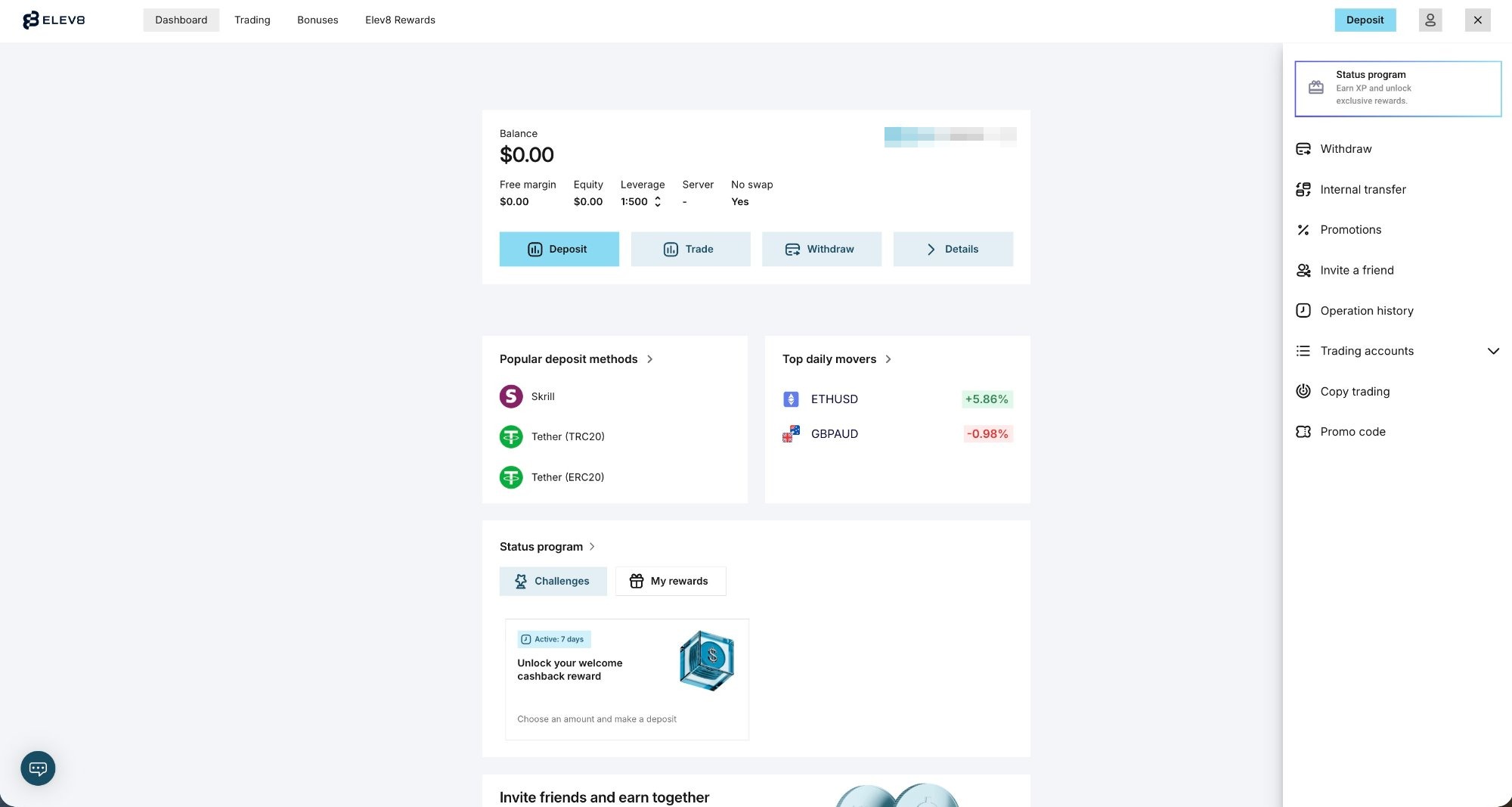
From the dashboard you jump straight into the platform where live bid/ask prices for every instrument are shown. That's where your real, binding spread lives — not in any article, including this one.
The honest note: spread isn't the only cost
Two things we want to be straight about, because copied "lowest spread" content usually skips them:
- Spreads change. Every pip figure here — ours and everyone else's — is a snapshot of published terms and third-party observations. The spread on your screen is the one that counts, and it floats.
- The spread isn't your only cost. Even with commission-free trading, holding positions overnight can incur swap/rollover charges per the broker's published terms, and your bank or payment provider may add charges on funding. Currency conversion can apply too. Factor these in before calling a broker "cheap" on spread alone.
And the wider caveat we repeat across this site: OctaFX/Elev8 is offshore-regulated (Mauritius FSC and Comoros MISA), not tier-1. A tight spread is about cost, not about the strength of your protection — keep the two separate when you decide.
Bottom line
OctaFX (Elev8) is commission-free, so the spread is your real cost, and for EUR/USD that typical cost floats around ~0.6–1.1 pips per the broker's published terms — a range, with "from" figures being best-case. Spreads widen on news, off-hours and exotic pairs, and they differ by account type. The one move that beats every quoted number: open the platform and read your own live bid/ask before you trade. That figure is the only one that binds you.
The broker in this guide
Commission-free trading, copy trading, MT4/MT5 and OctaTrader. Minimum deposit from $25 (varies by method). Offshore-regulated (Mwali/Comoros) — read our full review before you decide.
Open OctaFX (Elev8) account →FAQ
Does OctaFX (Elev8) charge a commission?
No — OctaFX uses a commission-free model on its standard MT4, MT5 and OctaTrader accounts, so your trading cost is the spread only. Overnight positions can still incur swap/rollover charges per the broker's published terms.
What is the typical EUR/USD spread on OctaFX?
Published sources put it in a floating range of roughly 0.6–1.1 pips, with the lower 'from' figures being best-case. It's variable, not fixed — the exact number changes with the market and shows live in your platform.
Are OctaFX spreads fixed or floating?
Floating (variable). They move with live market liquidity, widen around major news and off-hours, and differ by account type and instrument. Always check the current spread in the platform before you trade rather than relying on a quoted figure.
How do I check my live spread?
Log in, open your trading platform (MT4, MT5 or OctaTrader/Elev8Trader), select the pair, and subtract the bid (sell) price from the ask (buy) price to get the current spread in pips. Many platforms also display the spread directly in the symbol list.
Is a low spread the same as low risk?
No. The spread is a cost measure, not a safety measure. OctaFX/Elev8 is offshore-regulated (Mauritius FSC, Comoros MISA), not tier-1. Judge cost and protection separately.
Check your live spread before you trade
Open a free OctaFX (Elev8) account, load the platform, and read the current bid/ask on any pair — no copied pip numbers, just your real cost.
📢 OctaFX is now Elev8 — same broker, same account. You’ll see the Elev8 name and logo after you click.
Open OctaFX (Elev8) account →Trading forex/CFDs carries significant risk. This is general information, not financial advice.