Fees, spreads & minimums
OctaFX (Elev8) Leverage: 1:500, 1:1000 & the Risk (2026)
What leverage OctaFX offers, how margin actually works with a worked example, and the honest risk — leverage amplifies losses just as much as gains.

 Reviewed by TalhaUpdated 2026-07-11
OctaFX (now Elev8) offers leverage up to 1:500 as a global standard, with 1:1000 available in some regions or promotions, and 1:30 under EU rules. Leverage lets you control a large position with a small deposit — the broker effectively lends you the rest — so your margin is only a fraction of the trade's full size. That cuts both ways: the exact same leverage that magnifies a gain magnifies a loss just as fast. Below we explain the real numbers (they vary by entity and region), how margin is calculated with a worked example, and the risk you're taking on before you turn the dial up.
Contents
See your real leverage on a live account
The leverage that binds you is the one set on your own account — which depends on your region and entity. Opening an OctaFX (Elev8) account is free and takes about 3 minutes, then you can see your available leverage before you trade.

📢 OctaFX is now Elev8 — same broker, same account. You’ll see the Elev8 name and logo after you click.
Open OctaFX (Elev8) account →Trading forex/CFDs carries significant risk. This is general information, not financial advice.
What leverage actually is
Leverage is borrowed buying power. When you trade with 1:500 leverage, every $1 of your own money controls $500 of market position — the broker fronts the difference, and you only post a small deposit, called margin, to hold the trade open. It's written as a ratio (1:100, 1:500, 1:1000) where the second number is how many times your own capital is multiplied.
The appeal is obvious: a small account can take a meaningful position, and a favourable move returns far more than it would unleveraged. But leverage doesn't change the size of a market move or its odds — only how much of the position your deposit is exposed to. A 1% move is still 1%; at 1:500 it lands on a position 500 times larger than your margin, so the effect on your account is dramatic in both directions.
- Leverage — the multiple of your capital you can control (e.g. 1:500).
- Margin — the deposit locked to keep a leveraged position open.
- Notional / position size — the full market value of the trade, not just your margin.
Keep that last distinction in mind: your margin is a deposit, but your exposure is the full notional. That gap is the whole story of leverage — and of its risk.
OctaFX (Elev8) leverage: the real numbers
OctaFX (Elev8) is a high-leverage broker by design, but the maximum you can actually use depends on the entity and region you trade under — so treat the headline figure as a ceiling, not a promise. Across published sources the picture is:
| Setting | Max leverage | Applies to |
|---|---|---|
| Global standard | up to 1:500 | Most non-EU clients |
| Some regions / promotions | up to 1:1000 | Specific conditions only — not universal |
| EU rules (ESMA / CySEC) | 1:30 | EU retail cap |
| Crypto CFDs | much lower (one source cites ~1:25) | Crypto instruments |
Figures reflect the broker's published terms and third-party observations at the time of writing. Leverage varies by entity and region — the binding number is the one your own account shows.
Two honest points about those rows. First, 1:1000 is not the default — it appears in specific regions or promotional conditions, so you should never assume you'll get it. Second, the 1:30 EU figure is a regulatory cap set by ESMA/CySEC for EU retail traders. It matters here because of who Elev8 actually is: the former OctaFX group's CySEC (EU) entity was not carried into the Elev8 rebrand — Elev8 now operates only through offshore entities (Mauritius FSC and Comoros MISA). So the 1:30 EU tier reflects the rule that applied under the old Cyprus entity, not a protection Elev8 currently extends to EU residents — more on that in the caveat section below.
How margin works (a worked example)
The single formula that governs everything is simple:
Required margin = position size ÷ leverage
The higher the leverage, the smaller the margin you need to lock up for the same position. To see it in numbers, take one standard lot of EUR/USD. A standard lot is 100,000 units of the base currency, so the position size (notional) is 100,000 units. Here's the margin that position ties up at different leverage settings:
| Leverage | Calculation | Margin required |
|---|---|---|
| 1:500 | 100,000 ÷ 500 | ≈ 200 units (~$200) |
| 1:100 | 100,000 ÷ 100 | ≈ 1,000 units (~$1,000) |
| 1:30 (EU cap) | 100,000 ÷ 30 | ≈ 3,333 units (~$3,333) |
Margin shown in base-currency units; the exact figure in your account currency depends on the live EUR/USD rate, which your platform applies for you.
The pattern is the point: at 1:500 one standard lot ties up only about $200; drop to 1:30 and the same trade demands over $3,000. Higher leverage frees up capital so a small account can open a big position — exactly why it's tempting, and exactly why it's dangerous. Your deposit funds that margin, so it doubles as your buffer against the trade going wrong.
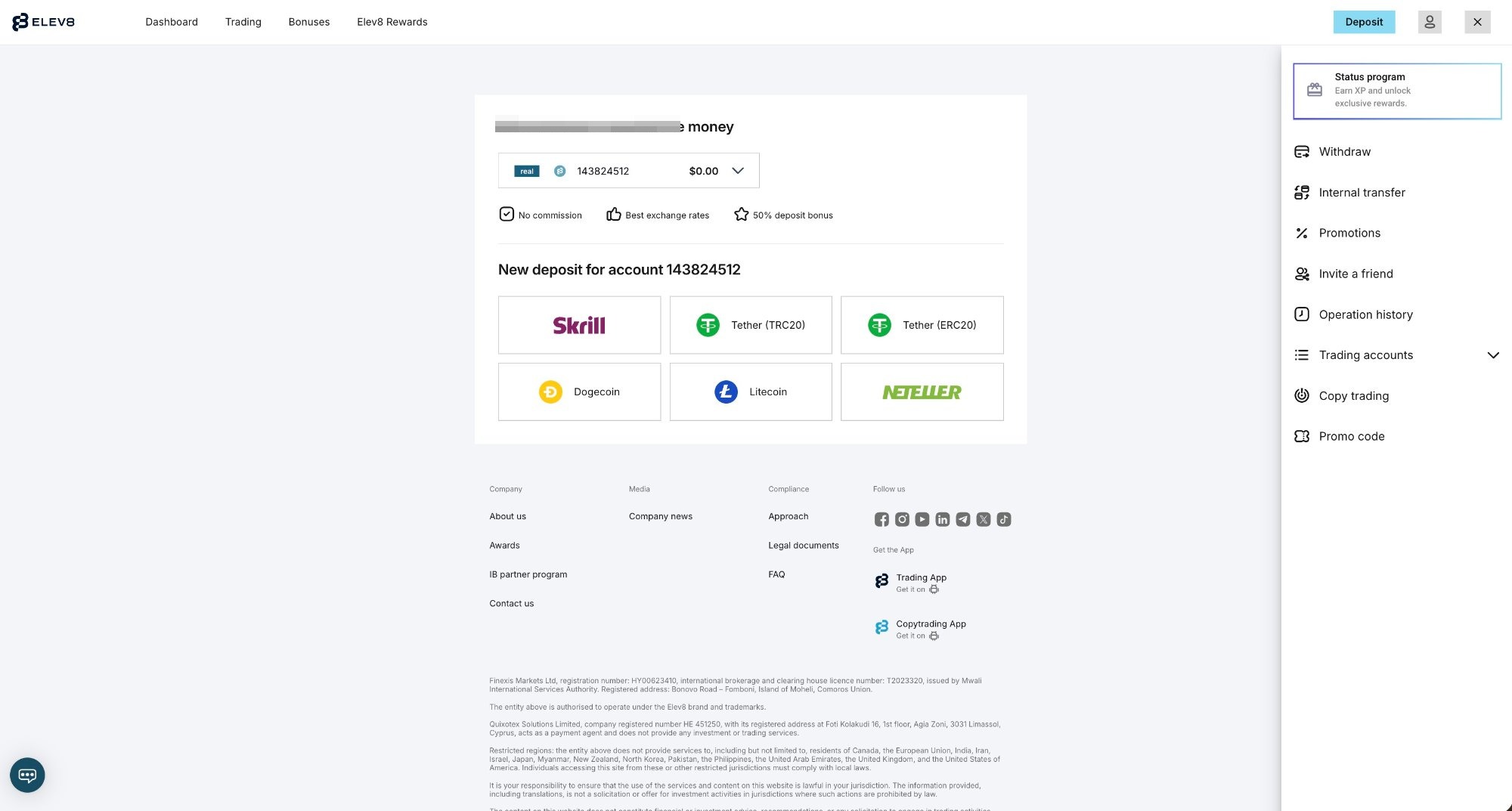
If you'd rather not do this by hand, our free profit & margin calculator works out required margin, pip value and profit/loss for a trade once you enter the lot size, pair and leverage.
The risk: leverage amplifies losses
This is the part marketing glosses over, so we'll be blunt: leverage multiplies losses at exactly the same rate it multiplies gains. There is no asymmetry in your favour. If anything, the risk is worse than the reward, because a big enough loss can close your positions before the market ever comes back.
Stay with the one-standard-lot EUR/USD trade. On a standard lot, a one-pip move is worth roughly $10. So:
- A 20-pip move in your favour ≈ +$200.
- A 20-pip move against you ≈ −$200.
Now overlay the margin from the last section. At 1:500, that trade only tied up about $200 of margin — so a roughly 20-pip adverse move can equal your entire posted margin on the position. At 1:30, the same trade required about $3,333, so a 20-pip move is a much smaller slice of your committed capital and you have far more room before trouble. That's the trade-off in one line: higher leverage = thinner buffer = faster stop-out.
When losses erode your usable margin past the broker's threshold you get a margin call and, if it continues, a stop out — the platform automatically closes positions to stop the account going further into the red. High leverage brings that threshold much closer. It's why experienced traders often use far less than the maximum on offer: the ceiling is 1:500 or 1:1000, but nothing forces you to trade near it. Position sizing and a stop-loss matter more than the number itself.
Negative-balance protection & the offshore caveat
What happens if a violent move blows straight through the stop out and drives your balance below zero? The broker states it applies negative-balance protection: in its own words — stated in its copy-trading terms — its risk-management system means clients "cannot lose more than they initially invested," and if a balance becomes negative due to a stop out, the broker says it will "compensate the difference and bring your account balance back to zero." On paper, that caps your downside at the money you deposited.
Two honest qualifications belong right next to that:
- It's the broker's own policy, not a tier-1 guarantee. It's stated in the broker's published terms — not the same as the negative-balance protection a top-tier regulator (like the FCA or ESMA/CySEC) legally mandates, because Elev8 doesn't operate under one.
- Elev8 is offshore-regulated only. It runs through the FSC in Mauritius (licence GB21027161) and MISA in the Comoros (licence T2023320) — offshore authorities, not tier-1. The former CySEC (EU) entity was not carried into the Elev8 brand, so EU-style investor-compensation and the mandated 1:30 retail cap do not apply here.
The takeaway isn't "don't trade" — it's that leverage risk and regulatory risk stack: you're using high leverage and relying on an offshore broker's own stated protections. Size your deposit as money you can afford to lose, and read the broker's current terms rather than a copied summary. Our OctaFX (Elev8) review covers the safety picture in full.
How to choose and check your leverage
The maximum leverage is a ceiling, not a target. The more useful skill is knowing what your account is actually set to and choosing a level you can survive. A few practical rules:
- Check your real setting in the Personal Area. Log in to your OctaFX (Elev8) dashboard — your available and selected leverage for each account shows there, and it reflects your region and entity, not a blog's headline figure.
- Start well below the maximum. You can open a 1:500 account and still trade small. Beginners are usually better served by conservative sizing than by maxing the ratio; the high number is optional.
- Let position size, not leverage, define your risk. Decide how many dollars you're willing to lose on a trade first, then size the lot to fit — leverage just determines how much margin that lot locks up.
- Always use a stop-loss. A stop caps the loss on a position before a margin call or stop out is ever in play. On a leveraged account it's not optional.
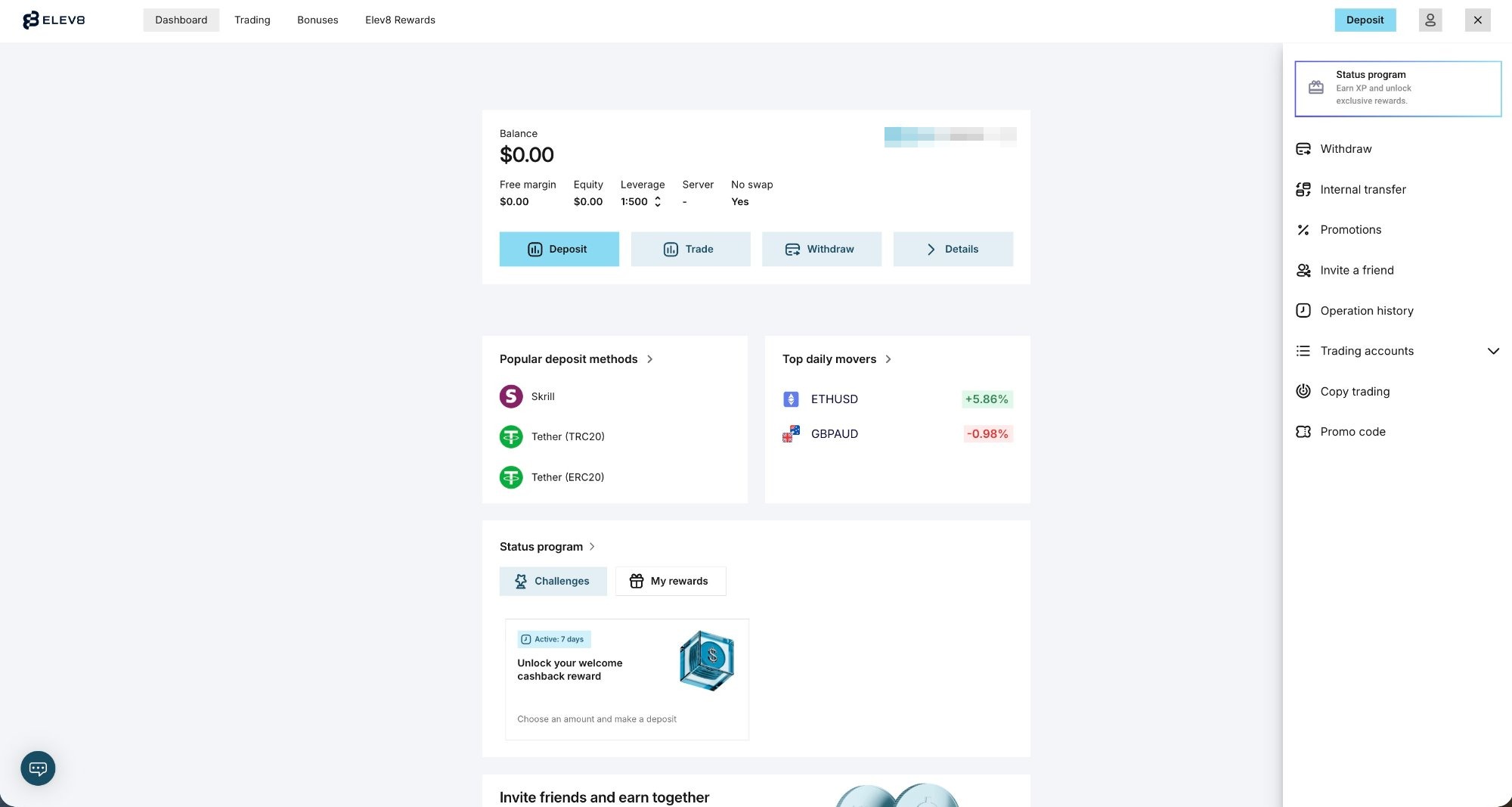
From the dashboard you manage your accounts and can see the leverage tied to each one before you place a single trade. That's the number that binds you — not the maximum quoted in any article, including this one.
Bottom line
OctaFX (Elev8) leverage runs up to 1:500 as a global standard, with 1:1000 in some regions or promotions and 1:30 under EU rules — it varies by entity and region, so never treat 1:1000 as universal. Margin is simply your position size divided by leverage, which means the higher the ratio, the smaller your buffer and the faster a losing trade reaches a stop out. The broker states it provides negative-balance protection, but that's its own offshore-regulated policy (Mauritius FSC, Comoros MISA), not a tier-1 guarantee. Use the high ceiling as an option, not an instruction: trade well below the maximum, size positions to a loss you can absorb, and check the leverage on your own account before you fund it.
The broker in this guide
Commission-free trading, copy trading, MT4/MT5 and OctaTrader. Minimum deposit from $25 (varies by method). Offshore-regulated (Mwali/Comoros) — read our full review before you decide.
Open OctaFX (Elev8) account →FAQ
What is the maximum leverage on OctaFX (Elev8)?
Up to 1:500 as a global standard, with 1:1000 available in some regions or promotional conditions and 1:30 under EU rules. It varies by entity and region, so 1:1000 is not universal — your available leverage shows in your own Personal Area once your account is open.
How is margin calculated on OctaFX?
Required margin = position size ÷ leverage. For one standard lot of EUR/USD (100,000 units), margin is about 200 units at 1:500, about 1,000 at 1:100, and about 3,333 at 1:30. The exact figure in your account currency depends on the live rate, which the platform applies for you.
Is high leverage dangerous?
Yes — leverage amplifies losses at the same rate as gains, and higher leverage means a thinner margin buffer, so a losing trade reaches a margin call or stop out faster. Most experienced traders use far less than the maximum on offer and always trade with a stop-loss.
Does OctaFX (Elev8) have negative-balance protection?
The broker states it does: its risk-management system means clients cannot lose more than they invested, and it says it will bring a negative balance back to zero. Note this is the broker's own offshore-regulated policy, not a protection mandated by a tier-1 regulator like the FCA or ESMA.
Can EU traders get 1:500 on Elev8?
No. EU rules (ESMA/CySEC) cap retail forex leverage at 1:30, and in any case Elev8 operates only through offshore entities (Mauritius FSC, Comoros MISA) — the former CySEC/EU entity was not carried into the Elev8 brand, so EU-style protections and the 1:30 retail framework do not apply through Elev8.
Check your leverage before you size a trade
Open a free OctaFX (Elev8) account, load the dashboard, and see the exact leverage and margin tied to your account — no copied figures, just your real numbers.
📢 OctaFX is now Elev8 — same broker, same account. You’ll see the Elev8 name and logo after you click.
Open OctaFX (Elev8) account →Trading forex/CFDs carries significant risk. This is general information, not financial advice.