Fees, spreads & minimums
OctaFX (Elev8) Profit Calculator: Pip Value & Margin (2026)
How to work out profit, pip value and required margin for an OctaFX (Elev8) trade — the plain-English maths, a worked EUR/USD example, and a free calculator that does it for you.

 Reviewed by TalhaUpdated 2026-07-11
Every OctaFX (Elev8) trade comes down to three numbers: how many pips you make, what each pip is worth, and how much margin you must post. Because OctaFX is commission-free, the maths is simple — the same standard formulas every forex platform uses. Below we walk through each step with a real EUR/USD example (a 50-pip move on one standard lot ≈ $500), show how margin changes with leverage, and point you to our free profit calculator so you never do it by hand.
Contents
Run the numbers, then open a live account
Our free profit calculator sizes any trade in seconds. When you're ready to trade the numbers for real, opening an OctaFX (Elev8) account is free and takes about 3 minutes — from a $25 minimum deposit.

📢 OctaFX is now Elev8 — same broker, same account. You’ll see the Elev8 name and logo after you click.
Open OctaFX (Elev8) account →Trading forex/CFDs carries significant risk. This is general information, not financial advice.
The three numbers behind every trade
Working out what an OctaFX (Elev8) trade will make — or cost — collapses into three questions:
- How many pips did the price move? Your raw result, in the smallest standard price increment.
- What is each pip worth? This turns a price move into money, and depends on your lot size.
- How much margin must you post? The deposit the broker locks to let you open a leveraged position.
Get those three and everything else — profit, loss, break-even — falls out of them. OctaFX (Elev8) is commission-free, so there's no separate ticket fee to add; the only cost baked in is the spread (more below). These formulas aren't OctaFX-specific — they're the standard forex maths, so you can sanity-check any broker with them.
If you'd rather skip the arithmetic, our free profit calculator does all three steps instantly: enter your pair, lot size, entry and exit, and it returns pips, pip value, profit/loss and required margin. The sections below explain exactly what it's doing so the output never looks like a black box.
Step 1: Count the pips
A pip is the standard unit a currency price moves in. For most pairs it's the fourth decimal place — 0.0001. So EUR/USD going from 1.0850 to 1.0900 is a move of 0.0050, or 50 pips. The formula:
- Pips = (exit price − entry price) ÷ pip size
The common exception is yen pairs: because the yen quote has fewer decimals, a pip on USD/JPY (and other JPY pairs) is the second decimal place — 0.01. A move from 157.00 to 157.50 on USD/JPY is therefore 50 pips too. Gold (XAU/USD) is another special case. When you're unsure, the calculator already has the correct pip size built in for each instrument.
Direction sets the sign, not the size: a 50-pip move is 50 pips whether you were long or short — a gain if the market went your way, a loss if it went against you.
Step 2: Pip value and profit
Pips only become money once you know what a pip is worth, and that depends on your position size:
- Position size (units) = lots × contract size. One standard lot = 100,000 units of the base currency for FX pairs. So 1.0 lot = 100,000 units, 0.10 lot = 10,000, 0.01 lot = 1,000.
- Pip value = pip size × position size. For a USD-quoted pair like EUR/USD, that lands in US dollars.
For one standard lot of EUR/USD: pip value = 0.0001 × 100,000 = $10 per pip — the well-known rule of thumb. It scales down cleanly: about $1 per pip on a 0.10 lot, $0.10 on a 0.01 lot.
Profit or loss is then pips × pip value, or equivalently:
- Profit/Loss = (exit − entry) × position size × direction
| Input | Value | How it's derived |
|---|---|---|
| Trade | Buy 1.0 lot EUR/USD | Entry 1.0850 → Exit 1.0900 |
| Pips | 50 | (1.0900 − 1.0850) ÷ 0.0001 |
| Position size | 100,000 units | 1.0 × 100,000 |
| Pip value | $10 / pip | 0.0001 × 100,000 |
| Profit | +$500 | 50 × $10 (= 0.0050 × 100,000) |
A worked EUR/USD example. Pip value and profit are in the pair's quote currency — US dollars here.
The same logic on a yen pair lands in yen: one standard lot of USD/JPY has a pip value of 0.01 × 100,000 = ¥1,000 per pip, converted to your account currency at the current rate. Rather than track that per instrument, plug your trade into the free profit calculator and read the profit/loss straight off.
Step 3: The margin you must post
You don't need a position's full value in your account — that's the point of leverage. The broker locks a fraction, the required margin, and lets you control the rest:
- Required margin = position notional ÷ leverage, where the notional is lots × contract size in the base currency.
Take the same one-lot EUR/USD trade. The notional is €100,000. At 1:500 the margin is 100,000 ÷ 500 = €200, about $217 converted at the 1.0850 entry — all you'd hold to open a position worth over a hundred thousand.
Leverage is the only variable that changes this figure, and it changes it a lot:
| Leverage | Margin on 1.0 lot EUR/USD |
|---|---|
| 1:100 | ≈ $1,085 |
| 1:200 | ≈ $543 |
| 1:500 | ≈ $217 |
Margin figures are approximate, using an entry near 1.0850 for conversion. Leverage varies by entity, region and promotion.
Important: OctaFX (Elev8) leverage is not one universal number. Published sources report up to 1:500 as the global standard, 1:1000 in some regions or promotions, and 1:30 for EU (CySEC) clients — so the margin your account requires depends on the cap that applies to you. The calculator lets you pick the leverage to see your own figure rather than assume the highest applies.
Don't forget the spread (your real cost)
A profit calculation on price alone is the gross result. Because OctaFX (Elev8) is commission-free, your one real trading cost is the spread — the gap between the buy (ask) and sell (bid) price that you start every trade behind by.
The spread is quoted in pips, so it folds straight into the maths above. Published sources put OctaFX's typical EUR/USD spread in a floating range of roughly 0.6–1.1 pips (the lower "from" figures are best-case). On one standard lot, where each pip is about $10, a ~0.7-pip spread is roughly $7 of built-in cost — so the 50-pip, +$500 example is really closer to +$493 once the entry spread is counted.
Two things to keep straight:
- Spreads float. They widen around major news and thin off-session hours, and differ by account type and instrument — majors like EUR/USD are tightest; exotics and some CFDs are wider.
- Overnight positions can add swap. Holding past the daily rollover may incur a swap/rollover charge per the broker's published terms.
For how the commission-free model works and how to read your live spread, see our OctaFX (Elev8) spread guide. The honest rule: the binding spread is the live one in your platform, not a figure copied into a blog.
Use our free profit calculator
It uses exactly the formulas above, so the output is auditable, not magic. The workflow:
- Read your live prices. Log in to your OctaFX (Elev8) dashboard and open your platform — MT4, MT5 or OctaTrader/Elev8Trader — for the current bid and ask.
- Enter the trade. Put your pair, lot size, direction and leverage into the calculator, plus an intended entry and target exit.
- Read the four outputs. Pips, pip value (in the quote currency), profit/loss and required margin appear at once, so you can size a position you can afford before placing it.
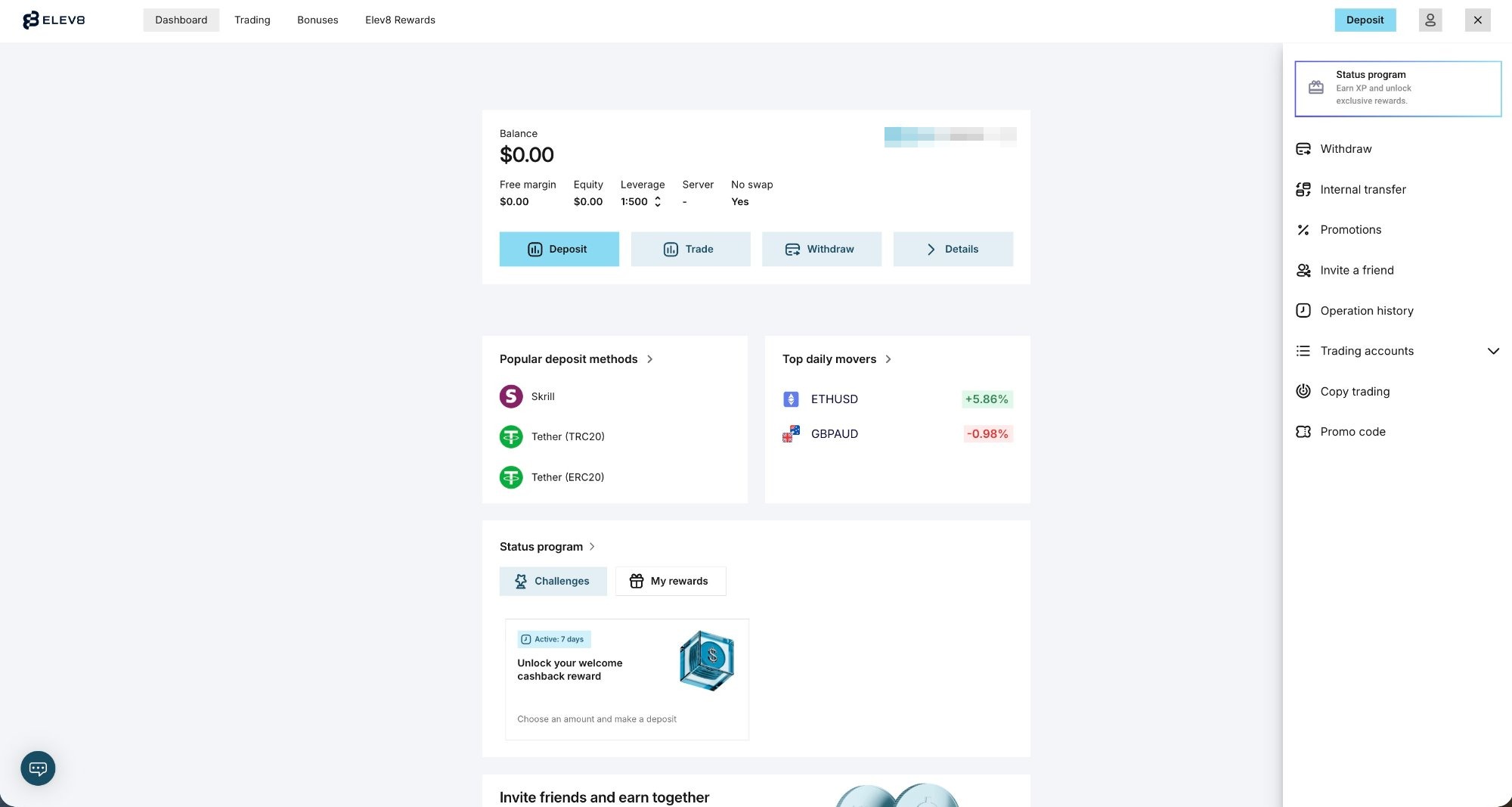
From the dashboard you jump into the platform where the live bid/ask lives — the price you feed the calculator. One honest caveat: the tool doesn't pull live FX rates, so pip value and profit/loss come out in the pair's quote currency. If your account currency differs, convert at the current rate.
The honest caveats: leverage and regulation
A calculator makes the upside look tidy, so two honest points before you act on its numbers.
Leverage cuts both ways. The reason a $217 margin can control a six-figure EUR/USD position is leverage — and the same force that turns a 50-pip move into +$500 turns 50 pips against you into −$500. A small required margin is not a small risk. OctaFX (Elev8) does state a risk-management system so that, in its words, clients "cannot lose more than they initially invested" — negative-balance protection that stops your balance going below zero. That caps the worst case at your deposit; it doesn't stop you losing that deposit. Size positions you can afford to lose, not the biggest the leverage allows.
Regulation is offshore. Cost maths is one thing; the strength of your protection is another. OctaFX (Elev8) operates through offshore entities — the FSC in Mauritius and MISA in the Comoros — not a tier-1 regulator, and the former CySEC (EU) entity was not carried into the Elev8 brand, so there's no EU/ESMA investor protection. A precise profit figure says nothing about the safety of the venue; judge the two separately.
To open a real account you'll also need to clear the minimum deposit (from $25, varying by method and region) before these numbers apply to real money.
Bottom line
Calculating an OctaFX (Elev8) trade is three steps: count the pips (0.0001 on most pairs, 0.01 on yen pairs), turn them into money via pip value (≈ $10 per pip on one standard lot of EUR/USD, so 50 pips ≈ $500), and check the margin (notional ÷ leverage — about $217 on that trade at 1:500). Subtract the spread, since commission-free means the spread is your real cost, and remember leverage varies by region. Rather than run it by hand, let our free profit calculator do the four numbers for you — then judge the venue on its offshore regulation separately from the maths.
The broker in this guide
Commission-free trading, copy trading, MT4/MT5 and OctaTrader. Minimum deposit from $25 (varies by method). Offshore-regulated (Mwali/Comoros) — read our full review before you decide.
Open OctaFX (Elev8) account →FAQ
How do I calculate profit on an OctaFX (Elev8) trade?
Profit = (exit − entry) × position size × direction, where position size = lots × contract size (100,000 units per standard lot). For example, one standard lot of EUR/USD from 1.0850 to 1.0900 is a 50-pip move at about $10 per pip, so roughly +$500 gross — before the spread. Our free profit calculator does this instantly.
What is the pip value on OctaFX?
Pip value = pip size × position size. On one standard lot (100,000 units) of EUR/USD that's 0.0001 × 100,000 = about $10 per pip. It scales with lot size: roughly $1 per pip on a 0.10 lot and $0.10 on a 0.01 lot. Yen-pair pip value lands in yen (about ¥1,000 per pip on one standard lot).
How much margin does an OctaFX trade need?
Required margin = notional ÷ leverage, where notional is lots × contract size. One standard lot of EUR/USD (€100,000) at 1:500 needs about €200, roughly $217 near a 1.0850 entry. Leverage varies by entity and region — up to 1:500 globally, 1:1000 in some regions or promotions, and 1:30 for EU (CySEC) clients — so your margin depends on the cap that applies to you.
Does OctaFX charge a commission on top of the spread?
No — OctaFX (Elev8) is commission-free on its standard MT4, MT5 and OctaTrader accounts, so your main trading cost is the spread only (a typical floating EUR/USD range of about 0.6–1.1 pips). Overnight positions can still incur swap/rollover charges per the broker's published terms.
Is the profit calculator accurate for my real account?
It uses the standard forex formulas, so the maths is correct, but it doesn't pull live prices or FX conversion rates — pip value and profit/loss come out in the quote currency, and you supply your own entry and exit. Treat the outputs as an estimate, and read your live bid/ask in the platform before trading. OctaFX/Elev8 is also offshore-regulated (Mauritius FSC, Comoros MISA), not tier-1.
See these numbers on your own account
Open a free OctaFX (Elev8) account, load the platform, and read your live bid/ask — then plug your real entry and exit into the calculator to size a position you can afford.
📢 OctaFX is now Elev8 — same broker, same account. You’ll see the Elev8 name and logo after you click.
Open OctaFX (Elev8) account →Trading forex/CFDs carries significant risk. This is general information, not financial advice.