How-to guides
OctaFX (Elev8) Trading: What You Can Trade & How It Works (2026)
The full instrument line-up — forex, metals, indices, energies, crypto CFDs and shares — plus how Market Execution, trading hours, lot sizes and margin rules actually work.
 Reviewed by TalhaUpdated 2026-07-11
OctaFX — now trading as Elev8 — lets you trade a broad multi-asset line-up from one account: around 35 forex pairs, metals like gold and silver, up to ten stock indices, energies, a range of crypto CFDs and both share CFDs and real (non-leveraged) shares — roughly 260+ instruments in total. Everything runs on commission-free Market Execution, where your cost sits in the spread rather than a separate ticket fee. This guide explains what you can actually trade and how the mechanics work — execution, trading hours, minimum and maximum trade sizes, and the margin rules that decide when a losing position gets closed — with an honest note on the offshore regulation behind it all.
Contents
Try the full market line-up free
The best way to explore what you can trade is to open a free OctaFX (Elev8) account, load the web terminal, and browse forex, metals, indices, crypto and shares on a demo before you risk anything. Sign-up takes about 3 minutes.

📢 OctaFX is now Elev8 — same broker, same account. You’ll see the Elev8 name and logo after you click.
Open OctaFX (Elev8) account →Trading forex/CFDs carries significant risk. This is general information, not financial advice.
What you can trade at a glance
OctaFX rebranded to Elev8 on 9 February 2026 — octafx.com now redirects to elev8.com — but the broker stated the change was to brand and visual identity only, so the markets, accounts and trading conditions carry over unchanged. Whichever name you see, you are trading the same multi-asset line-up. If you want the wider picture of who the broker is before you read about the markets, start with our what is OctaFX (Elev8)? overview.
At the top level, the broker groups its markets into a handful of asset classes. Here is what is on the menu, using the broker's own stated figures (treat every count as approximate — line-ups change, and the exact number depends on the platform you choose):
| Asset class | What it covers | Roughly how many |
|---|---|---|
| Forex | Major, minor and some exotic currency pairs | Around 35 pairs |
| Metals | Precious metals — gold and silver | Gold & silver |
| Indices | Stock-index CFDs (e.g. US and global benchmarks) | Up to 10 indices |
| Energies / commodities | Oil and natural gas | A handful (e.g. Brent, WTI, natural gas) |
| Crypto CFDs | Cryptocurrencies traded as CFDs | Around 30+ |
| Shares | Share CFDs plus real, non-leveraged shares | 150+ share CFDs, plus 100+ real shares |
Instrument counts are the broker's stated, approximate figures and vary by platform and over time — confirm the live list inside your account.
Add those together and the broker reports a total of around 260+ instruments. One important nuance: the exact number you can access depends on which platform you trade on — the broker's own figures put MetaTrader 5 at the top of the range, with the proprietary Elev8Trader and MetaTrader 4 carrying smaller subsets. So "260+" is the broad ceiling, not a guarantee that every instrument is on every platform.
The instrument line-up in detail
Here is what each asset class actually contains, based on the broker's official markets page. Remember that all counts are approximate and the per-class leverage figures the broker publishes are stated maximums that vary by entity and region — never assume the highest number applies to you (more on that in the leverage section).
Forex — around 35 currency pairs
Forex is the core of the offering: the broker lists around 35 of the most-traded currency pairs, covering majors (such as EUR/USD, GBP/USD and USD/JPY), minors (crosses without the US dollar) and some exotics. Forex carries the highest stated leverage of any class here, but that maximum is region-dependent.
Metals — gold and silver
On the precious-metals side you can trade gold and silver against the US dollar. These are the classic "safe-haven" instruments many traders use to diversify away from pure currency exposure.
Indices — up to 10
The broker offers up to ten of the most popular stock indices as CFDs — benchmarks that track a basket of large companies (US indices such as the tech-heavy NAS100, the broad SPX500 and the US30 are commonly referenced). Index trading lets you take a view on a whole market rather than a single share.
Energies and commodities
In energies you will find oil and natural gas — specifically Brent Crude, WTI (US crude) and natural gas. These are volatile, news-driven markets, so they suit traders who follow the commodities calendar.
Crypto CFDs — around 30+
Cryptocurrencies are offered as CFDs, not as coins you own and hold in a wallet. The broker markets around 30-plus well-known cryptocurrencies; the exact count varies between sources, so treat it as a ballpark rather than a fixed figure. Because these are CFDs, you are speculating on price movement, and crypto carries a much lower maximum leverage than forex.
Shares — CFDs plus real, non-leveraged stock
Shares come in two distinct flavours here, and the difference matters:
- Share CFDs — the broker lists around 150 stocks from roughly 16 exchanges, traded on leverage as CFDs. You never own the underlying share; you trade the price difference.
- Real (non-leveraged) shares — separately, the broker lists 100-plus public companies as actual Shares with no leverage. This is closer to conventional investing than CFD speculation.
That split — leveraged share CFDs alongside a real-stock offering — is unusual for an offshore forex broker and worth understanding before you place an order, because the risk profile of the two is very different.
How execution works: Market Execution, commission-free
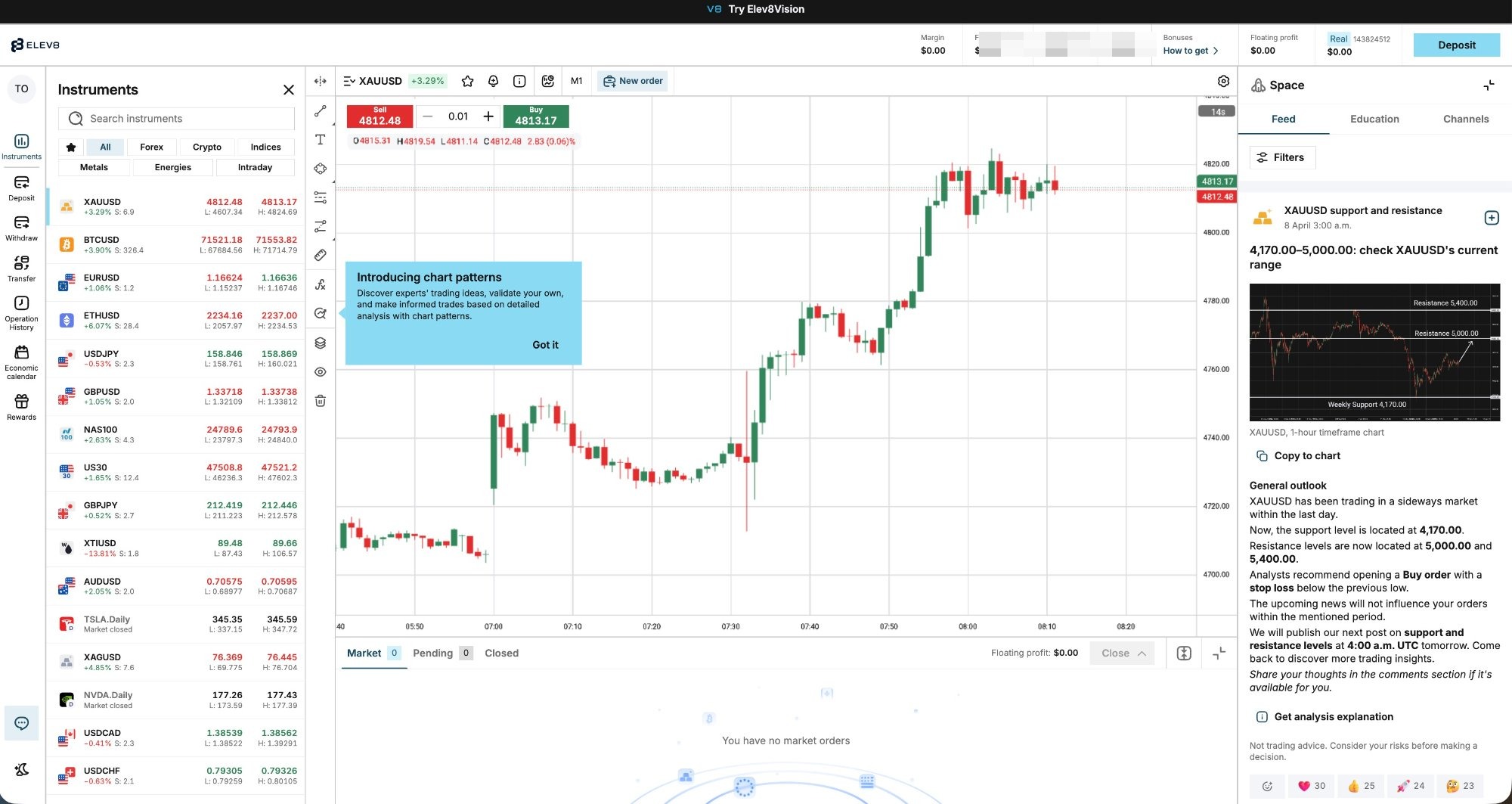
Knowing what you can trade is half the picture; the other half is how the broker fills your orders and charges you. On OctaFX (Elev8) the model is refreshingly simple to describe:
- Market Execution across the current platform line-up — MetaTrader 4, MetaTrader 5 and the proprietary Elev8Trader (formerly OctaTrader). Your order is filled at the best available market price rather than a fixed dealer price.
- Commission-free on every instrument. There is no separate per-trade ticket commission. The broker states "no commissions" across all three platform options, with the cost built into a spread markup instead.
In other words, your trading cost lives entirely in the spread — the small gap between the buy and sell price — and nowhere else on the standard offering. That makes cost easy to reason about: there is no commission table to decode, just a floating spread that widens and narrows with the market. We break down exactly what that spread means for your bottom line in the OctaFX spread guide.
One point of honesty for readers who have seen older reviews: some legacy write-ups describe an OctaFX cTrader or "true ECN" account with raw, near-zero spreads. On the current line-up that is no longer the setup to expect — the broker's own accounts page lists only MT4, MT5 and Elev8Trader, all on the same commission-free, spread-only model. If a third-party page promises you an ECN/cTrader account, verify it against the broker's live terms before you rely on it.
Trading hours: forex ~24/5, everything else varies
Different markets keep different hours, and this is an area where it pays to check rather than assume. The broad shape is:
- Forex trades roughly 24 hours a day, five days a week (Monday to Friday, around the clock) with a short daily technical break. There is no weekend forex trading — the currency market closes over the weekend.
- Metals, indices, energies and crypto each have their own per-instrument hours. Indices and commodities are not 24/5 — they follow the sessions of their underlying exchanges — while crypto has some limited weekend availability.
Because the exact open and close times are set in the platform's server time and can change (the broker adjusted trading hours for several instruments in February 2026), we deliberately do not print specific clock times here — they would be out of date the moment a schedule shifts. Instead, the broker publishes a full, per-instrument trading-hours schedule, including its technical breaks. Before you plan a trade around a market open or an economic release, check the live schedule on the broker's trading-hours page for the instrument you have in mind.
The practical takeaway: treat forex as an all-week-but-not-weekend market, and treat everything else as "check first." A position you think is open may actually be in a closed session, and gaps can open between sessions.
Trade sizes: minimum lot and maximum order
Trade size is measured in lots. One standard lot is a large position, so brokers let you trade fractions of it. On OctaFX (Elev8):
- Minimum trade size is 0.01 lot (a "micro" lot) across all three platforms. That is the smallest position you can open, which keeps the barrier to entry low for beginners and for anyone testing a strategy small.
- Maximum order size depends on the platform you choose:
- Elev8Trader — up to 50 lots per order
- MetaTrader 5 — up to 500 lots per order
- MetaTrader 4 — up to 200 lots per order
So if you trade very large size, the platform you pick is not just about the interface — it also sets your per-order ceiling. For the vast majority of retail traders, though, the 0.01-lot minimum is the number that matters: it means you can start small, keep your risk per trade tiny, and scale up only as your account and confidence grow. If you want to see how lot size translates into pip value and required margin before you trade, run the numbers with our free profit calculator or read the profit-calculator guide.
Margin, Margin Call and Stop Out
Because most of these instruments trade on leverage, you only put down a fraction of a position's value as margin — but that also means a losing trade can eat into your account quickly. Two levels decide what happens when it does:
- Margin Call at 25%. When your margin level falls to 25%, you are warned that your account is running low on free margin and that positions are at risk. This is the point to add funds or reduce exposure.
- Stop Out at 15%. If the margin level keeps falling to 15%, the platform starts automatically closing your positions to stop the account going further into the red. You do not choose which trades close — the system does, to protect the balance.
These are hard, mechanical thresholds, not suggestions. The higher your leverage, the faster a moving market can carry you from a comfortable margin level down toward the Stop Out — which is exactly why leverage cuts both ways. Leverage on OctaFX (Elev8) varies by entity and region (the broker's forex maximum is high in some regions but capped far lower elsewhere, such as 1:30 for EU clients), so never assume the headline figure applies to your account. We explain how leverage and margin interact, with a worked example and the risk, in the OctaFX leverage guide.
What it costs to trade
Pulling the mechanics together, your total cost of trading on OctaFX (Elev8) comes down to a short list — and notably it does not include a per-trade commission on the standard offering:
- The spread — the main and, on most instruments, the only direct trading cost, since the accounts are commission-free. Floating EUR/USD spreads are typically reported in the region of 0.6 to 1.1 pips (a variable range, with "from" figures being best-case); see the spread guide for the full picture.
- Leverage's hidden cost — leverage is not a fee, but it magnifies both the spread's impact and your risk, which is a real cost if it pushes you toward a Stop Out. Understand it via the leverage guide.
- Swaps — overnight financing. Note the broker's accounts are swap-free / Sharia-compliant by default, so overnight swap charges are not the standard cost they are at many brokers.
To turn all of this into an actual number for a specific trade — pip value, margin required and potential profit or loss — the simplest route is to plug your instrument, lot size and leverage into our free profit calculator. It does the arithmetic the platform would, so you can size a position sensibly before you open it rather than discovering the margin requirement after the fact.
Bottom line
OctaFX (Elev8) gives you a genuinely broad multi-asset menu from one account: around 35 forex pairs, gold and silver, up to ten indices, energies, 30-plus crypto CFDs and both share CFDs and real non-leveraged shares — roughly 260+ instruments in total, with the exact list depending on your platform. Trading runs on commission-free Market Execution, so your cost is the spread; the minimum trade is 0.01 lot, the maximum order depends on the platform, and the account is governed by a 25% Margin Call / 15% Stop Out pair of thresholds.
All of that is easy to like — but the fundamentals don't change with a slick line-up. Leverage varies by entity and region (never assume the top figure), and the broker is offshore-regulated, not tier-1, so your protection is weaker than at an FCA- or ASIC-supervised firm. Try the markets on a free demo first, calculate your risk before every trade, and only fund an amount you can afford to lose.
The broker in this guide
Commission-free trading, copy trading, MT4/MT5 and OctaTrader. Minimum deposit from $25 (varies by method). Offshore-regulated (Mwali/Comoros) — read our full review before you decide.
Open OctaFX (Elev8) account →FAQ
What can you trade on OctaFX (Elev8)?
One account gives you a broad multi-asset menu: around 35 forex currency pairs, metals (gold and silver), up to 10 stock indices, energies such as oil and natural gas, around 30-plus cryptocurrencies as CFDs, plus roughly 150 share CFDs and a separate offering of 100-plus real, non-leveraged shares — about 260+ instruments in total. All counts are the broker's approximate, stated figures and vary by platform.
Does OctaFX (Elev8) charge commission?
No. The current accounts are commission-free across MetaTrader 4, MetaTrader 5 and the proprietary Elev8Trader — there is no per-trade ticket commission. Your cost is built into the spread instead. Older reviews that mention a cTrader or ECN account with raw spreads plus commission do not reflect the current line-up, which is commission-free and spread-only.
What is the minimum and maximum trade size?
The minimum trade size is 0.01 lot (a micro lot) on all three platforms. The maximum order size depends on the platform: up to 50 lots on Elev8Trader, up to 500 lots on MetaTrader 5, and up to 200 lots on MetaTrader 4. For most retail traders the 0.01-lot minimum is what matters, because it lets you start small and control risk.
What are the Margin Call and Stop Out levels?
Margin Call is triggered at a 25% margin level and Stop Out at 15%. At Margin Call your account is warned that free margin is running low; if the level keeps falling to 15%, the platform automatically starts closing your open positions to protect the balance. Because these are hard thresholds, higher leverage can reach them faster.
When can I trade — is it 24/7?
Forex trades roughly 24 hours a day, five days a week, with a short daily technical break and no weekend trading. Metals, indices, energies and crypto each follow their own per-instrument hours — indices and commodities are not 24/5, and crypto has limited weekend availability. Because exact times are set in server time and change, check the broker's live trading-hours page for the instrument you want.
Ready to place your first trade?
Open a free account, practise on a demo with the minimum 0.01 lot to feel how Market Execution and margin work, then go live from just $25 when you're confident.
📢 OctaFX is now Elev8 — same broker, same account. You’ll see the Elev8 name and logo after you click.
Open OctaFX (Elev8) account →Trading forex/CFDs carries significant risk. This is general information, not financial advice.